A Key Enabler in Drug Development: AI-Powered Image Recognition Enables Precise Analysis of Laboratory Animal Behavior
- Date: 2026-08-31
- Update: 2026-08-31
- Source: 國家衛生研究院
- Views: 182
Scientists with Taiwan’s National Health Research Institutes (NHRI) have made a discovery that may lead to a new application of AI technology for animal welfare.
In recent years, rapid advances in artificial intelligence (AI) have driven the development of a wide range of technologies and applications across diverse fields. By integrating technological expertise across departments and institutions, our research team has developed a system capable of real-time monitoring of laboratory animals and precise analysis of their behavior. The technology is designed to support the assessment of safety and efficacy during the drug-development process. The findings were published in the internationally recognized journal iScience in November 2024.
Biomedical research often relies on complementary evidence from three key areas: cell-based studies, animal studies, and human clinical trials. Breakthroughs in basic research, together with rigorous safety assessments of animals, provide the foundation for advancing potential treatments into human studies. In particular, clear evidence from laboratory animals of a potential treatment’s safety and efficacy is often essential before further development can proceed. During the COVID-19 pandemic, concerns arose that shortages or loss of research manpower could disrupt ongoing R&D activities. This prompted our team to explore ways to monitor laboratory animals in real time and quantitatively assess their quality of life, with the goal of ensuring that research aimed at extending lifespan also takes quality of life into consideration.
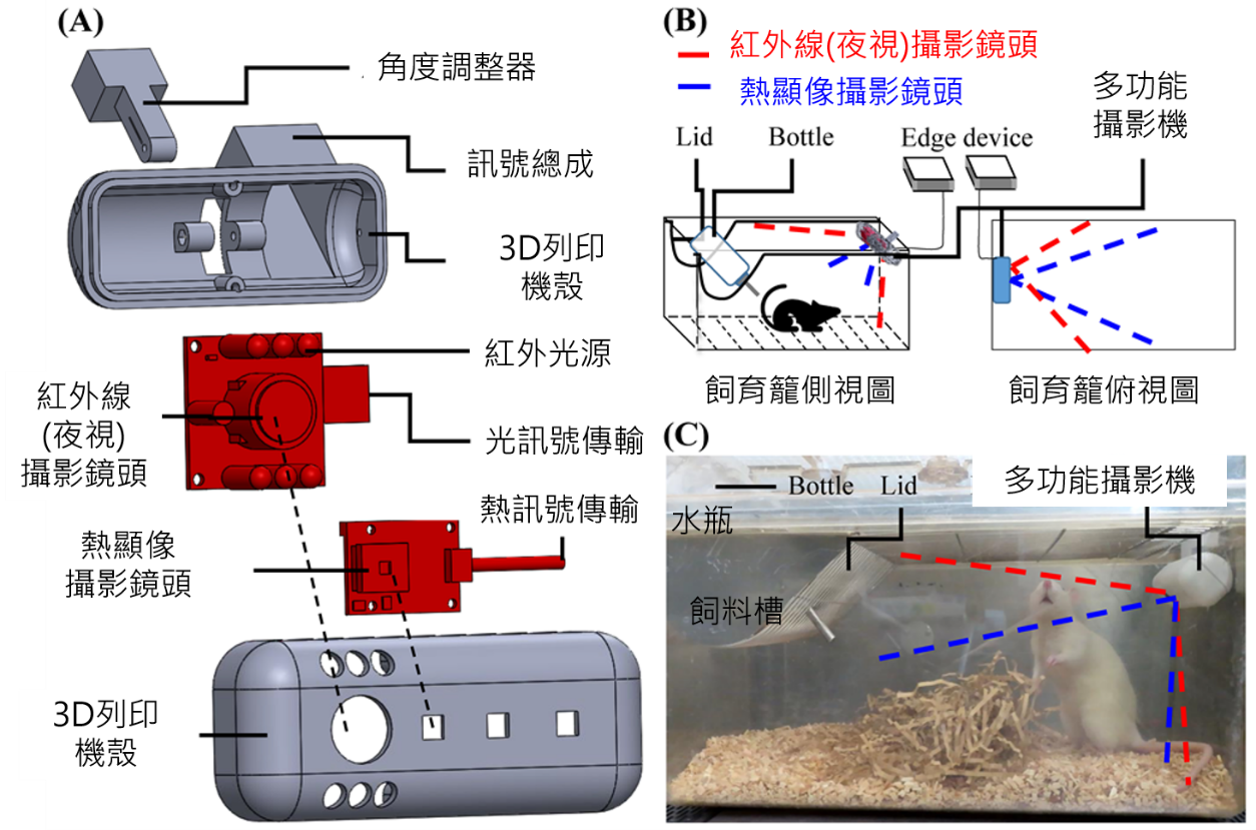
The research team brought together expertise from the Institute of Biomedical Engineering and Nanomedicine and the Laboratory Animal Center at NHRI, as well as from National Tsing Hua University. The team developed a multifunctional imaging recorder that can be installed on currently used laboratory animal cages. Classification models were established to distinguish various movements and behaviors of laboratory animals, incorporating deep learning and AI-based recognition technologies. The system enables real-time, 24-hour continuous AI-based recognition of at least eight types of animal behavior. Classification accuracy exceeded 90% for four of these behaviors, while accuracy across all eight behaviors exceeded 80%.
The use of laboratory animals is governed by rigorous ethical standards both in Taiwan and internationally. Among the most important and widely recognized of these standards are the 3Rs: Reduction, Replacement, and Refinement. The research team’s AI-powered image recognition system for precise analysis of laboratory animal behavior, combined with facility-wide wireless network infrastructure and information security management, can not only support compliance with the refinement principle for laboratory animal research and enhance the reliability of biomedical research, but also facilitate the digital transformation and sustainable operation of laboratory animal facilities.
Building on these R&D achievements, NHRI’s Institute of Biomedical Engineering and Nanomedicine and the research team it assembled are pleased to share their experience and look forward to working with partners across sectors as AI applications continue to expand rapidly.
Related links
Related photos
-
合照1.jpg
-
合照.jpg
-
陳仁焜副研究員2.jpg
-
儀器設計.png
-
陳仁焜副研究員.jpg